Last updated:
Grease Trap Cleaning Tampa runs grease trap maintenance plans for restaurants, hotels and multi-site operators across Tampa, Hillsborough, Pinellas and Pasco. Grease trap maintenance on a plan means the pumping date is booked before the trap reaches its limit, not after a backup or an inspector's notice.
A good schedule answers two questions: what does your jurisdiction require, and how fast does your unit actually fill? The rule sets the longest you can wait. The measured fill rate decides whether you need to come in sooner.
What happens on the first visit
Every plan starts with a baseline visit:
- Confirm the jurisdiction. Your address decides which program applies. A "Tampa" mailing address can still be unincorporated Hillsborough.
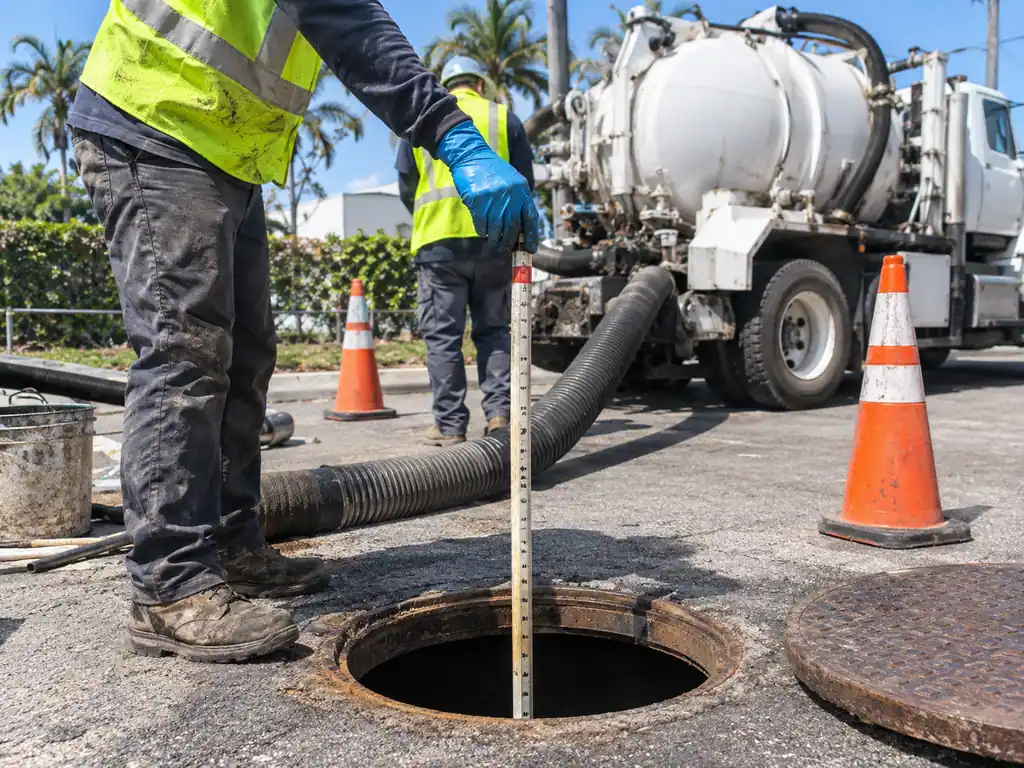
- Pump and measure. A full pump-out, with the grease and solids depth recorded before pumping.
- Set the interval. The rule's maximum, shortened if the measured fill rate says the unit will pass 25% (20% in Pasco) first.
- Book the dates. The next visits go on the calendar, and each one is logged with a signed manifest.
Grease trap maintenance schedules by jurisdiction
The maximum interval depends entirely on where the kitchen drains:
| Where the kitchen drains | Interval | The rule |
|---|---|---|
| City of Tampa | No fixed days | Pump before solids pass the outlet invert (~8 in), grease and solids exceed 25% of capacity, the unit stops retaining grease, a backup occurs, or sanitary waste enters. Tampa Code Ch. 26 Art. VII, Sec. 26-306 |
| Hillsborough County (unincorporated) | At least every 90 days | Serviced at least every 90 days; contents never over 25% of wetted volume; alternate schedules by individual approval. Hillsborough County Grease Management FAQ (Ch. 120 / Ord. 06-31 Art. VII) |
| City of Temple Terrace | No fixed days | Pump when solids pass the outlet invert (~8 in), grease and solids exceed 25%, or the unit stops retaining grease. Temple Terrace Code Sec. 22-304 |
| Pinellas County Utilities | At least every 30 days | Pumped at least every 30 days; grease layer under 6 in and solids under 8 in; variance never over 180 days, voided if missed, not transferable. Pinellas County Code Sec. 126-613 |
| City of St. Petersburg | At least every 30 days | Pumped at least monthly; variance fee $275, maximum 180 days. City of St. Petersburg FOG Best Management Practices Manual |
| City of Clearwater | Set by the city | In-ground interceptors monitored at least every 90 operational days; the Public Works Administrator sets each facility's pumping schedule; alternate frequencies on request; pump until empty and clean walls, baffles and pipes. Clearwater Code Sec. 32.189 |
| City of Largo | At least every 30 days | Contents removed once per 30 operational days unless the control authority approves an alternate frequency. Largo Code Sec. 23-120 |
| Pasco County Utilities | At least every 90 days | Cleaned and pumped every 90 days, or sooner once FOG and food sludge reach 20% of volume; pump until empty and clean walls, cross pipes, inlet and outlet. Pasco County Code Sec. 110-174 |
| State of Florida | No fixed days | No pumping frequency set. Haulers may not return grease waste or graywater to the trap and must dispose at a permitted facility. F.S. 403.0741; F.A.C. 62-705 |
Most programs also allow a longer schedule if you can prove the unit stays under its limit. Pinellas County and St. Petersburg grant variances of up to 180 days (St. Petersburg charges $275). Hillsborough County reviews alternate schedules case by case and requires the unit to stay under 25% throughout. Clearwater lets facilities request an alternate frequency from the Public Works Administrator. A plan with measured depths on every visit is the evidence a variance application needs.
What a maintenance plan keeps straight
- Dates: no visit slides past the rule's maximum.
- Depths: grease and solids measured on every visit, so the schedule tightens or loosens on evidence.
- Paperwork: a signed manifest each time. Florida requires you to keep manifests a year; Pinellas County, Pasco County and Temple Terrace require three.
- Reports: St. Petersburg wants a quarterly report and Largo wants hauler records sent in quarterly. Clearwater wants each pumping reported within five business days. The plan builds those deadlines in.
Multi-site operators
A group with kitchens in Tampa, Brandon and St. Petersburg is working under three different rules at once. One plan can keep each site on its own schedule, with records kept to the longest retention period that applies. For hotels and resorts, see hotel kitchen grease trap cleaning.
What's included
- Jurisdiction confirmed from your address
- Baseline pump-out with depths recorded
- Interval set by rule and measured fill rate
- Visits booked ahead of the rule's maximum
- Signed manifest every visit
- Report deadlines tracked (St. Pete, Largo, Clearwater)
- Evidence file for a variance application
- Schedule reviewed when the menu or volume changes
Pricing and payment
Plans are billed per visit at the rate for your unit. The annual cost is that rate times the visits your rule and fill rate require. Typical annual spend for a Tampa Bay restaurant is $2,500–$6,000 (low confidence, one commercial source). Run the cost estimator for your own figure. Ask for a written quote before any work starts. Prices on this site are typical market ranges, not quotes.